
Seamless Gutters vs. Sectional: Why Modern Homes Prefer Seamless
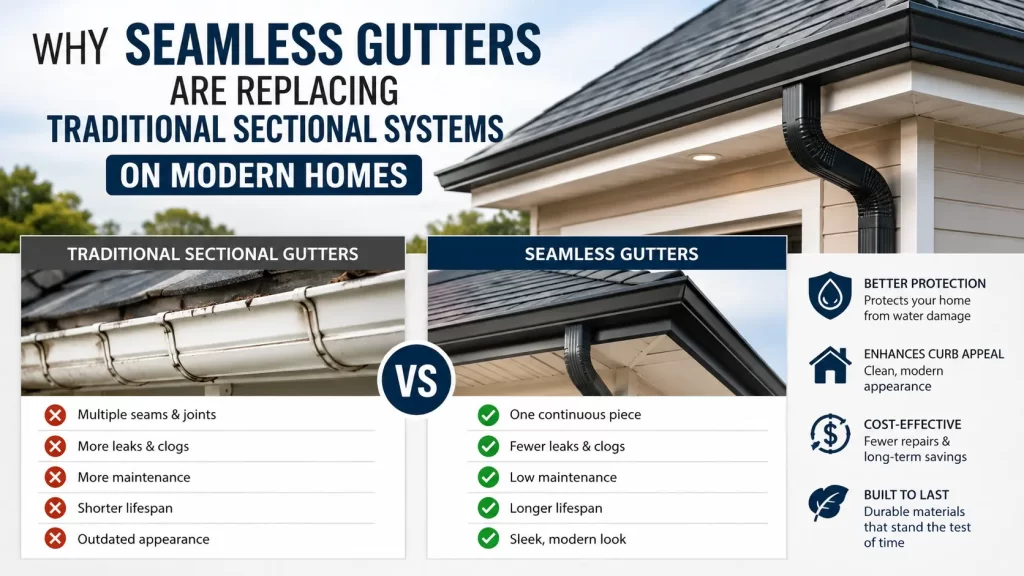
What Are Rain Gutters and Why Does Type Matter?
Rain gutters form the primary defense for your roof and home exterior. Mounted directly to the fascia board or eave line, a properly engineered gutter system collects rainwater runoff from the roof pitch, channels it through high-capacity downspouts, and discharges it safely away from your home’s foundation using splash blocks or underground drainage pipes.
Choosing the wrong gutter type, size, or material can lead to serious home maintenance issues over time, including:
- Foundation settling and basement flooding caused by uncontrolled water pooling around the perimeter.
- Fascia rot, soffit damage, and roof leak back-ups from clogged or overflowing gutters.
- Soil erosion and ruined landscaping due to heavy cascading roof runoff.
- Sagging and joint failure caused by heavy snow, ice dams, or inadequate hanger support.
Understanding how gutter materials, construction styles, and profiles perform in different weather conditions is essential before replacing your gutter system.
Gutter Materials Compared: Aluminum, Steel, Copper, Vinyl & Zinc
Selecting the right material determines your gutter system’s overall lifespan, maintenance requirements, weather resilience, and total cost. Below is a direct comparison of the primary gutter materials available today:
| Gutter Material | Average Lifespan | Estimated Cost (per linear ft.) | Best For | Key Pros | Key Cons |
|---|---|---|---|---|---|
| Aluminum | 20–30 years | $6 – $15 | Overall value & residential homes | Lightweight, 100% rustproof, easy to paint | Can dent under heavy impact (use heavy-gauge 0.032″) |
| Galvanized Steel | 15–20 years | $8 – $13 | Cold climates & heavy snow loads | High structural strength, thermal stability | Heavy; subject to eventual rust once zinc coating wears |
| Stainless Steel | 50+ years | $15 – $25 | Maximum strength & rust resistance | Virtually indestructible, never rusts or corrodes | High upfront cost; requires professional installation |
| Copper | 50–100 years | $18 – $35 | Luxury homes & historic restoration | Premium curb appeal, forms protective natural patina | Very expensive; requires specialized soldering skills |
| Vinyl (PVC) | 10–15 years | $3 – $6 | Low-budget DIY projects in mild climates | Cheap, lightweight, snap-together installation | Cracks in severe cold; sags under heavy rain or snow |
| Zinc | 30–50+ years | $15 – $25 | Custom architecture & longevity | Self-healing patina, durable, eco-friendly | Vulnerable to salt air in coastal regions; costly |
Deep Dive into Each Gutter Material
1. Aluminum Gutters (Best Overall Value)
Aluminum accounts for nearly 80% of residential gutter installations across North America. Because it contains no iron, aluminum will never rust, making it ideal for wet, humid regions. For optimal durability, always select heavy-gauge primary aluminum (0.032-inch thickness) rather than thinner economy grades (0.027-inch), which are prone to bending under heavy snow or ladder pressure.
2. Steel Gutters (Best for Extreme Snow & Cold)
Steel handles extreme temperature swings and high load capacities far better than aluminum or vinyl.
- Galvanized Steel: Coated in a protective layer of zinc to fight rust. Great for heavy ice conditions, though it must be kept free of standing water to prevent internal corrosion over time.
- Stainless Steel: Premium-grade steel that never rusts, pits, or degrades. It offers unmatched structural strength for homes in harsh winter climates, though at a significantly higher price point.
3. Copper Gutters (Best for Longevity & Historic Aesthetics)
Copper is an architectural-grade metal that lasts up to a century. It does not require painting; over time, natural oxidation turns bright copper into a rich green patina that acts as a protective barrier. Copper gutters require specialized installation with soldered joints to prevent leaks.
4. Vinyl / PVC Gutters (Best for Low-Budget DIY)
Vinyl gutters are lightweight, rust-free, and designed with snap-together fittings, making them accessible for DIY homeowners. However, they lack structural longevity. Exposure to UV rays causes PVC to become brittle over time, and freezing winters often lead to cracking or joint separation.
5. Zinc Gutters (Best Eco-Friendly Premium Option)
Similar to copper, zinc develops a natural protective patina that heals minor scratches over time. It requires no exterior coating or paint and offers a sleek, modern matte finish that lasts 30 to 50+ years.
Seamless vs. Sectional Gutters: Which Construction Style Is Best?
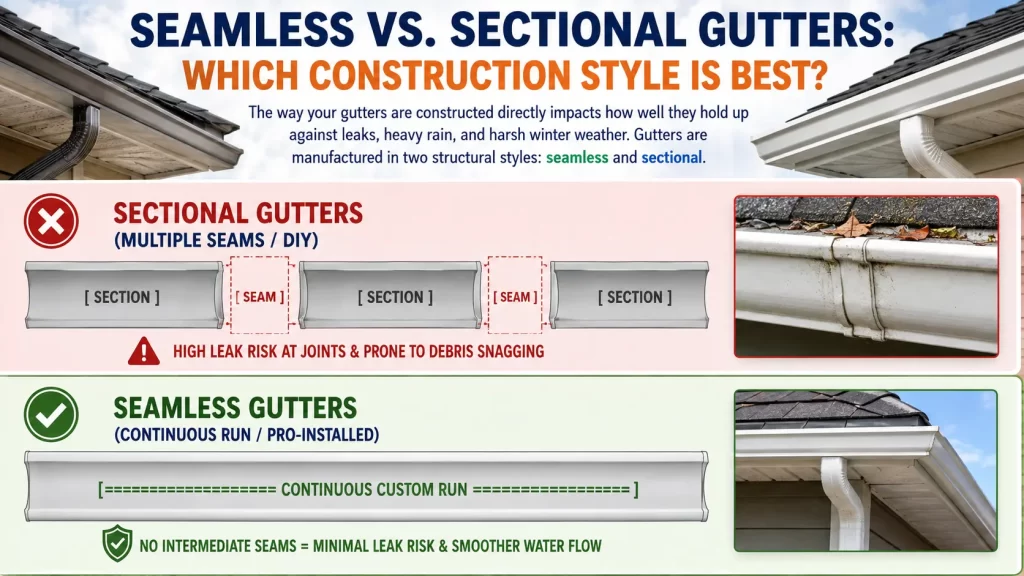
The way your gutters are constructed directly impacts how well they hold up against leaks, heavy rain, and harsh winter weather. Gutters are manufactured in two structural styles: seamless and sectional.
Sectional Gutters (Multiple Seams / DIY)
1. Seamless Gutters (Best Overall Performance)
Seamless gutters are custom-extruded on-site using a specialized roll-forming machine mounted on an installation truck. A continuous piece of heavy-gauge metal (typically aluminum or copper) is custom-cut to match the exact length of your roofline without any joints along straight runs.
Key Advantages:
- Eliminates Leak Points: Joints are the most common cause of gutter leaks. Seamless systems only have joints at corners (miters) and downspout outlets, reducing leak risk by up to 90%.
- Smoother Water & Debris Flow: Without interior seams, sealants, or ridges to catch leaves and roof grit, continuous troughs suffer far fewer clogs.
- Superior Structural Integrity: The continuous metal design provides higher rigid strength against heavy snow, ice-dam weight, and torrential rains.
- Clean Exterior Aesthetic: Delivers a sleek, custom-fitted look that blends seamlessly into the fascia board and roofline.
Trade-Offs:
- Requires professional delivery and installation (cannot be bought pre-fabricated off home improvement store shelves).
- Higher initial material and labor costs compared to basic DIY sectional options.
2. Sectional Gutters (Best for DIY Budget Repairs)
Sectional gutters are pre-cut, standard-length troughs (typically sold in 10-foot or 20-foot pieces) available at hardware stores. They are connected together along the eaves using snap-in connectors, seam brackets, or overlap joints sealed with gutter caulk.
Key Advantages:
- DIY Friendly: Easy for homeowners to transport, handle, and install using basic hand tools.
- Low Upfront Cost: Lower upfront purchase costs for materials.
- Modular Maintenance: Damaged sections can be easily unclipped and replaced individually without removing the whole run.
Trade-Offs:
- High Risk of Leaks: Rubber gaskets and caulk sealants break down under constant thermal expansion, contraction, and UV exposure, eventually leaking at the seams.
- Frequent Clogging: Seam overlaps create internal ledges that catch organic debris, twigs, and roof granules.
- Lower Lifespan: Weak joints reduce the overall weight capacity, making sectional systems prone to sagging, warping, or pulling away from fascia boards under heavy snow loads.
Comparison Summary: Seamless vs. Sectional
| Feature | Seamless Gutters | Sectional Gutters |
|---|---|---|
| Leak Risk | Extremely Low (Seams at corners only) | High (Seams every 10–20 feet) |
| Installation Method | Professional custom extrusion | DIY snap-together assembly |
| Maintenance Needs | Low (Fewer clogs, smooth flow) | High (Frequent clearing & seam resealing) |
| Structural Strength | High (Continuous metal run) | Moderate to Low (Joint weakness) |
| Relative Cost | Moderate to High | Low upfront |
Gutter Profiles & Styles: K-Style, Half-Round & Box Gutters
Gutter profiles determine both the visual style of your home’s exterior and how efficiently the system routes water off your roof.
1. K-Style Gutters (Most Popular Choice)
K-Style gutters feature a flat back that mounts flush against the fascia board, paired with a decorative outer profile resembling crown molding.
- Best For: Modern residential homes and high-rainfall regions.
- Key Benefit: Flat-back engineering makes installation straight forward, while the trapezoidal profile holds significantly more water volume than a round gutter of equivalent width.
- Water Capacity: A standard 5-inch K-style gutter carries more water than a 5-inch half-round gutter.
2. Half-Round Gutters (Best for Historic & Classic Homes)
Half-round gutters are semi-circular troughs with outer-curled edges. They require specialized external hanging brackets attached to the roof rafter tails or fascia.
- Best For: Historic restoration, Victorian homes, European architecture, and slate/tile roofs.
- Key Benefit: The smooth curved interior lacks sharp corners, making debris wash away easily and reducing internal rust traps.
- Trade-Off: Requires specialty hangers, carries less water per inch of width than K-style, and costs more to install.
3. Box & Fascia Gutters (Best for Commercial & Oversized Residential Needs)
Box gutters are large, square-shaped troughs integrated directly into the roof structure or fascia framing.
- Best For: Commercial buildings, flat roofs, steep architectural roof pitches, or torrential storm zones.
- Key Benefit: Offers maximum water capacity (6 to 8+ inches wide) designed to route torrential downpours away without overflowing roof edges.
Choosing the Right Gutter Configuration by Climate & House Type
| Climate / Need | Recommended Gutter Type | Recommended Size | Recommended Material |
|---|---|---|---|
| Standard Residential | Seamless K-Style | 5-Inch | 0.032″ Aluminum |
| Heavy Rainfall & Storms | Seamless K-Style | 6-Inch (Oversized) | Aluminum or Steel |
| Snow & Cold Climates | Seamless K-Style or Box | 6-Inch | Heavy Galvanized/Stainless Steel |
| Historic / Tile Roofs | Seamless Half-Round | 6-Inch | Copper or Zinc |
| Low-Budget DIY Repairs | Sectional K-Style | 5-Inch | Vinyl (PVC) or Aluminum |
Essential Gutter Components: Hangers, Downspouts & Guard Systems
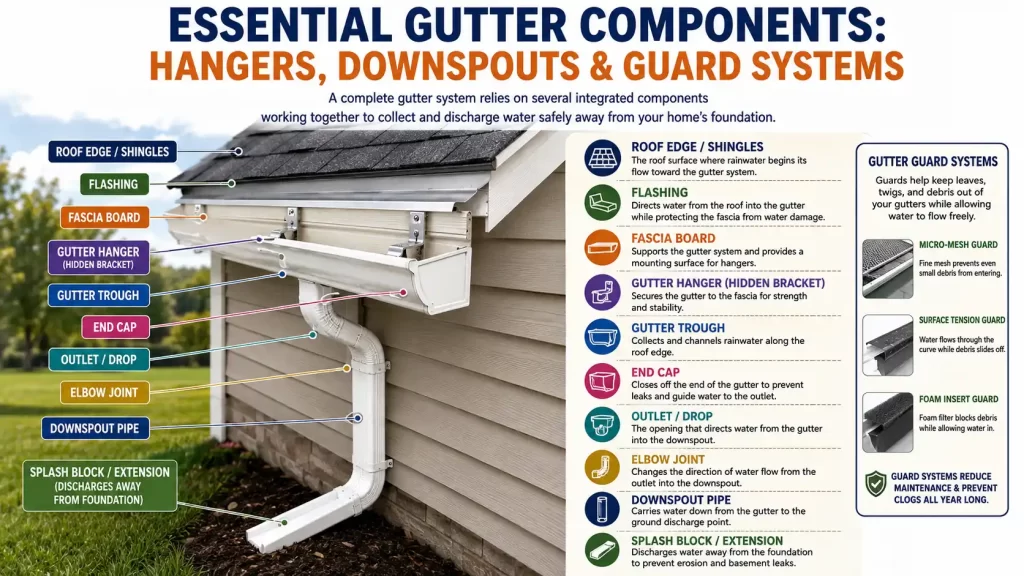
A complete gutter system relies on several integrated components working together to collect and discharge water safely away from your home’s foundation.
1. Gutter Hangers & Mounting Hardware
Gutter hangers secure the trough directly to the fascia board or roof rafters. Mounting hardware quality determines whether your gutters stay level or sag under heavy ice and snow loads.
- Heavy-Duty Hidden Hangers (Best Overall): Bracket hangers installed inside the gutter trough and fastened directly into the fascia board using stainless steel screws. Invisible from the ground, offering high structural support and clean curb appeal.
- Spike and Ferrule (Outdated): A metal tube inserted into the trough with a long spike driven through the front into the fascia. Prone to backing out over time as wood expands and contracts.
- Wrap-Around Strap Hangers: Metal straps attached directly to the roof deck beneath shingles. Essential for half-round gutters or homes without flat vertical fascia boards.
2. Downspouts, Outlets & Extensions
Downspouts carry accumulated rainwater from the roof trough down to ground level. Matching your downspout capacity to your roof pitch and local rainfall volume is critical to preventing gutter overflow.
- Standard Downspouts (2×3 Inch): Standard for 5-inch residential gutters handling light to moderate rainfall.
- Oversized Downspouts (3×4 Inch): Recommended for 6-inch gutters, high-pitch roofs, or regions prone to torrential downpours. They double water flow capacity and significantly reduce clogging from leaves and twig debris.
- Elbows, Outlets, and Splash Blocks: Curved A-style or B-style elbow joints direct water around architectural trim, while splash blocks and underground drainage extensions ensure discharged water lands at least 5 to 10 feet away from your home’s foundation walls.
3. Gutter Guards (Debris Protection Systems)
Gutter guards cover the top of the trough to prevent leaves, pine needles, and roof grit from blocking water flow, drastically reducing manual cleaning requirements.
| Gutter Guard Type | Filtration Efficiency | Durability | Best For | Trade-offs |
|---|---|---|---|---|
| Micro-Mesh Screen | Highest (Blocks fine pine needles & roof grit) | High (Stainless steel mesh) | All tree types, heavy pine needle areas | Requires occasional surface wiping to clear pollen/sap |
| Reverse-Curve (Helmet) | High (Uses water surface tension) | High (Hardened aluminum/plastic) | Heavy broadleaf trees (Oak, Maple) | Expensive; visible along the roofline; can overshoot in torrential rain |
| Screen Guards | Moderate (Blocks large leaves) | Moderate (Aluminum or plastic mesh) | Budget-conscious protection from large foliage | Small twigs and pine needles still slip through mesh holes |
| Foam / Sponge Inserts | Low | Low (1–3 year lifespan) | Temporary short-term protection | Absorbs water, trap |
Gutter Cost Breakdown & Installation Budgeting
Total replacement costs depend on linear footage, selected material, house height (single-story vs. two-story), and labor rates.
Average Installed Cost per Linear Foot (Materials + Professional Labor)
- Vinyl (Sectional DIY): $3 – $6 per linear ft.
- Aluminum (Seamless 0.032″): $8 – $16 per linear ft.
- Galvanized Steel: $10 – $18 per linear ft.
- Stainless Steel: $16 – $28 per linear ft.
- Copper / Zinc: $22 – $40+ per linear ft.
For an average single-family home requiring 150 to 200 linear feet of gutters, expect to pay between $1,200 and $3,200 for a complete professionally installed seamless aluminum system with oversized downspouts.
Maintenance Tips for Maximum Gutter Lifespan
- Clean Troughs Twice Yearly: Clear debris in late autumn (after leaves drop) and late spring to prevent water backups and fascia rot.
- Inspect Hanger Pitch: Ensure gutters slope downward toward downspouts at a rate of at least 1/4-inch per 10 linear feet to prevent standing water.
- Seal Joints & End Caps: Apply high-grade butyl or silicone gutter sealant to end caps, drop outlets, and corner miters every 3–5 years.
- Check Foundation Extensions: Verify that downspout splash blocks or drain pipes route runoff at least 6 feet away from foundation walls to prevent basement leaks and soil erosion.
How to Calculate the Right Gutter Size for Your Roof
To prevent overflow during extreme storms, your gutter trough and downspouts must match your roof’s total drainage area and your region’s maximum rainfall intensity.
1. Calculate Roof Pitch Factor
(Roof Pitch Inches per Foot -> Multiplier: 4/12 = 1.05 | 8/12 = 1.12 | 12/12 = 1.30)
2. Determine Effective Drainage Area
(Roof Length × Roof Width × Pitch Multiplier = Adjusted Square Footage)
3. Select Gutter Size Based on Area & Rainfall Intensity
(Standard 5-Inch K-Style: Up to 5,520 sq ft | Heavy 6-Inch K-Style: Up to 7,960 sq ft)
1. Calculate Your Roof’s Effective Drainage Area
A steep roof catches more wind-driven rain than a flat roof of the same square footage. Multiply your roof plane’s length by its width, then multiply by the Roof Pitch Factor:
- Flat to Low Pitch (up to 3/12): Multiply footprint by 1.0
- Medium Pitch (4/12 to 5/12): Multiply footprint by 1.05
- Steep Pitch (6/12 to 8/12): Multiply footprint by 1.12
- Very Steep Pitch (9/12 to 12/12): Multiply footprint by 1.30
2. Select 5-Inch vs. 6-Inch Gutters
- 5-Inch K-Style Gutters: Standard for most suburban homes with low-to-medium roof pitches and average rainfall rates. Handles up to 5,520 square feet of effective roof area per drainage run.
- 6-Inch K-Style Gutters (Oversized): Necessary for steep roof pitches, complex metal/tile roofs, or homes in heavy rainfall regions. A 6-inch gutter holds 40% more water volume than a 5-inch gutter, dramatically reducing overflow risk along valleys and straight runs.
Frequently Asked Questions (FAQ)
What type of rain gutters are best for heavy rain?
Seamless 6-inch aluminum or galvanized steel K-style gutters paired with oversized 3×4-inch downspouts are best for heavy rain. The seamless design prevents seam failure under high water velocity, while 6-inch troughs provide 40% more water-holding capacity than standard 5-inch systems.
Are seamless gutters worth the extra cost?
Yes. Seamless gutters eliminate straight-line joints where 90% of gutter leaks and clogs occur. Although they cost 20% to 40% more upfront than DIY sectional gutters, their longer lifespan, low maintenance, and protection against fascia rot make them far more cost-effective over time.
How long do aluminum rain gutters last?
High-quality, heavy-gauge aluminum gutters (0.032-inch thickness) last 20 to 30 years with regular cleaning and basic maintenance. They contain no iron, making them naturally rustproof even in highly humid climates.
Which gutter shape holds the most water?
K-style gutters hold significantly more water than half-round gutters of equivalent width. For maximum capacity on commercial buildings or large residential roofs, custom box gutters provide the highest volume handling.
Final Verdict: Choosing the Best Gutters for Your Home
For the vast majority of homeowners, seamless 0.032-inch aluminum K-style gutters provide the best combination of rust resistance, structural durability, affordability, and custom fit.
If you live in an area prone to severe snow loads or ice dams, upgrade to heavy-gauge galvanized or stainless steel. For luxury, historic, or coastal architectural applications where maximum longevity is required, copper or zinc systems offer unmatched aesthetic appeal and a century-long lifespan.
Also Read: Guide to Rain Gutter Installation
Disclaimer: The material and pricing estimates provided in this guide are for informational purposes only. Actual installation costs, material performance, and regional building codes vary based on local labor rates, roof architecture, and specific climate conditions. Always consult a licensed local roofing or gutter contractor to evaluate your property before starting a major installation or structural repair.